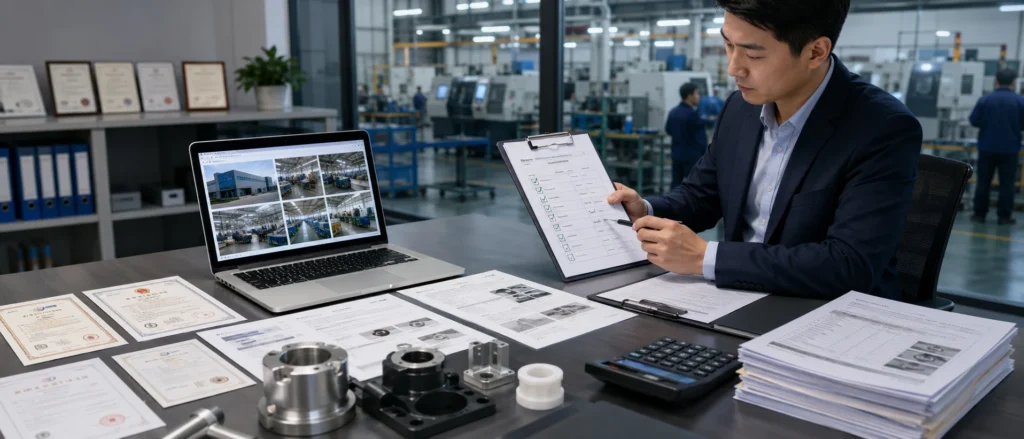
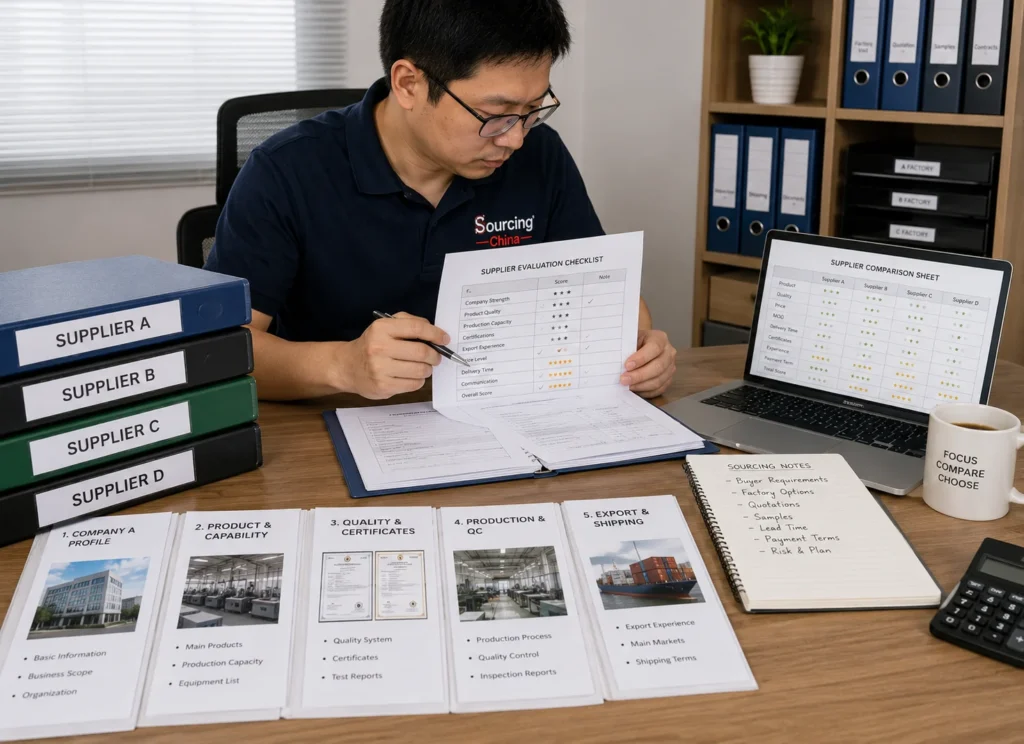
The quotation looks reasonable, the sample photographs are convincing and the salesperson wants a deposit before Friday. That is the point to stop moving quickly. Before money leaves the buyer’s account, the supplier’s legal identity, payment instructions and product claims should connect into one understandable record.
No background check can promise that the order will run smoothly. Its value comes before the transfer, when an unexplained company name or payment route can still be challenged. Keep a short list of open items beside the proforma invoice. Remove an item only after the supporting record arrives. If the buyer decides to proceed without it, note that decision and the reason.
Start with the Chinese legal company name
English company names are useful for communication, but several translations can refer to the same Chinese entity. Request the full business-licence image, with all edges and text visible. Copy the legal name in Chinese into the supplier file. Next to it, enter the Unified Social Credit Code, which normally contains 18 characters. Search with those details rather than relying on the brand used in emails.
Compare that legal name with the quotation, proforma invoice, contract, bank beneficiary and email signature. If the names differ, do not fill in the explanation yourself. The salesperson may represent a factory group, export company or trading partner. Ask each company to be identified and state which one sells the goods.
The European Commission’s China IP SME Helpdesk provides an official guide on searching basic Chinese company information through China’s National Enterprise Credit Information Publicity System. The official registry is a starting point for legal identity. It does not, by itself, prove factory capability or financial strength.
Read the registration record carefully
Check whether the company appears active and whether the Unified Social Credit Code matches the licence. Note the legal representative, registered address, establishment date and stated business scope. Review any visible abnormal-operation or administrative information that could require further advice.
Registered capital is often misunderstood. A large number on the record is not the same as cash available to complete your order. Likewise, an old establishment date does not show current factory capacity. Use registration data to establish identity and spot inconsistencies, not to award a quality score.

Separate the registered, sales and production addresses
A supplier may register at an office while producing in an industrial zone. Another company may handle exports from a city office. Ask for the purpose of every address: registration, sales, production, warehouse, packing and pickup.
Request a live video call from the claimed factory when an on-site visit is not yet justified. Ask the contact to move from the entrance sign to the relevant workshop, current production and packing area. A prepared promotional video is useful background, but it does not answer a live question.
For a large custom order, arrange a factory audit. Registration checks show that a company exists. The visit can examine whether the quoted product and processes are actually connected with the location.
Find out whether you are dealing with a factory or trader
A trading company can be a good supplier, especially for mixed products or smaller orders. The problem arises when its role is hidden and the buyer makes decisions based on a false factory claim. Ask directly: Who manufactures the quoted model? Can the factory change after sample approval? Which company will appear on certificates and shipping documents?
Look at the catalogue with some scepticism. A narrow technical range can support a factory claim, but catalogues can be copied. A broad range does not prove a problem either. Product-specific answers matter more. Ask about material, component versions, production steps, tooling and a recent manufacturing challenge.
Our comparison of a sourcing agent, trading company and buying office explains how the commercial role changes transparency and payment structure.
Test capability against the exact product
Send a few questions that require production knowledge. For a faucet, ask about body material, cartridge, finish control and leak testing. For a smart lock, ask for the mortise drawing, door-thickness range, firmware version and accessory set. For packaging machinery, confirm voltage, electrical components, sample material and the planned trial run.
Answers should agree with the quotation and sample. If the sales contact changes a material after technical questions begin, ask for a revised quotation. Never allow a lower-grade alternative to remain buried in chat history.
Match certificates and reports to the quoted model
Open the complete file rather than accepting a cropped certificate image. Compare the applicant or manufacturer, model list, product description, issue date and standard. Check whether the document covers the exact version being offered. A report for a related model may help a laboratory plan further work, but it should not be presented as direct evidence for your order.
Where possible, verify the document through the issuer or certification body’s own system. Regulated products may require specialist advice in the destination market. Supplier verification cannot decide legal compliance simply by collecting PDFs.
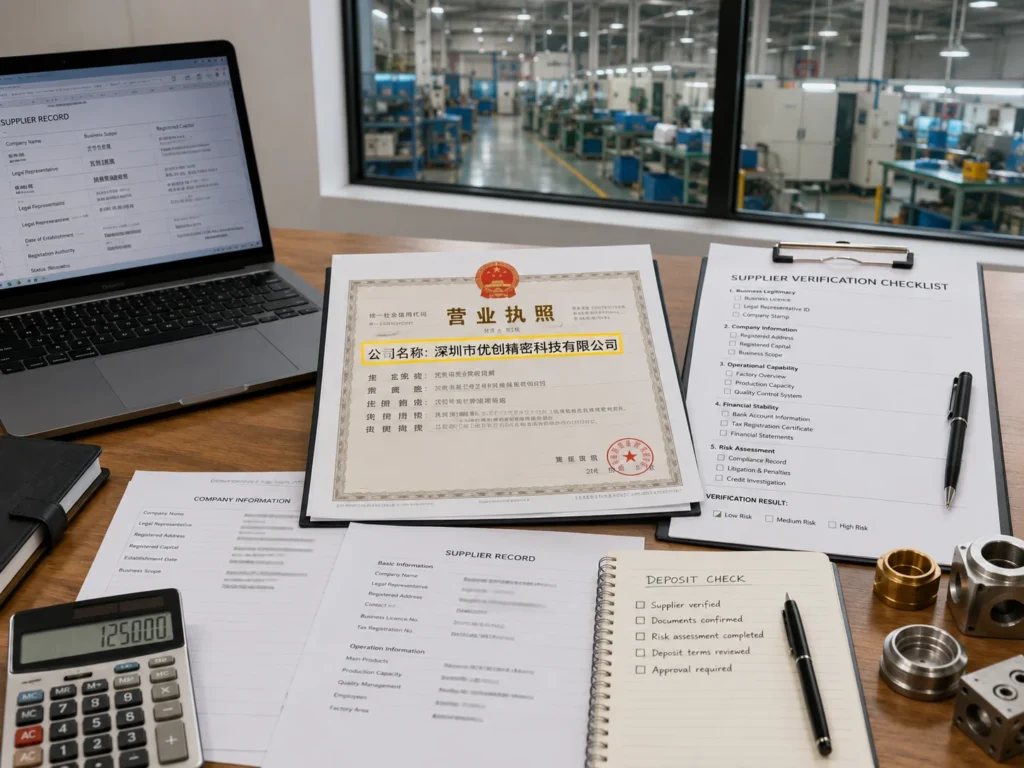
Identify exactly what the deposit will buy
A sample can look right while its production status remains unclear. Is it a stock item, hand-built prototype or unit from normal production? Record the sample version, date, photos and approved deviations. State whether the bulk order must match it for appearance, components and packing.
If a sample has not been tested, the deposit should not be treated as proof that the product works. Use sample management to record revisions and unresolved test points before the purchase order becomes fixed.
Verify the payment beneficiary through a second channel
The beneficiary name should make sense against the contract and supplier structure. If the seller asks for payment to another company, request the reason and supporting relationship. Do not send company funds to a personal account simply because the salesperson says it is faster.
A last-minute account change is a serious pause point. Email accounts can be compromised, and genuine suppliers can also change banking arrangements. Call a known contact using a number already on file. Confirm the new instructions through a second channel, then request an updated signed invoice or contract.
Also compare the country and currency of the account with the supplier’s explanation. An offshore account may be legitimate for an export seller, but it changes which company receives the money. The paperwork should reflect that arrangement before payment.
Never verify changed bank details by replying only to the message that announced the change. Use an independently retained phone number or another trusted contact route.
Read the PI and contract as an order-control file
Read the PI from top to bottom as though a colleague must place the order without opening the email thread. They should be able to identify both parties, the model being purchased, the ordered quantity and the agreed currency. The price basis, Incoterm, named location and deposit schedule should also be visible. Attach or reference the approved specification, artwork, packing file, sample version and inspection rule. “Standard quality” is not a usable substitute for those records.
Check what triggers the balance payment. It may be completion, passed inspection, shipping documents or another agreed event. Define who pays for correction and reinspection. For quotations that still contain gaps, use our guide on comparing Chinese supplier quotations before turning the quote into a purchase order.
Pause when several small mismatches form a pattern
- The supplier will provide only an English company name, not its Chinese legal identity.
- The bank beneficiary differs from the seller and no relationship is documented.
- The claimed factory cannot show a live product-specific production area.
- The certificate holder, manufacturer or model does not match the quoted goods.
- Technical answers conflict with the quotation or approved sample.
- The deposit request becomes urgent immediately after bank details change.
- The supplier resists putting material, packing or delivery promises in the contract.
One mismatch may have a reasonable explanation. Three unexplained mismatches deserve more than another reassuring message. Ask for records, arrange a video call or audit, seek professional legal advice, or move to another supplier.
Deposit verification record
| Area | Evidence | Release condition |
|---|---|---|
| Legal identity | Chinese name, licence, credit code and registry record | Entity is active and names are reconciled |
| Supplier role | Factory/trader explanation, address and product evidence | Buyer understands who manufactures and sells |
| Product | Specification, quotation and approved sample record | Bulk requirement is clear |
| Documents | Full certificate or report with model and holder | Scope fits the quoted product or gap is addressed |
| Payment | Contract, invoice and independently confirmed bank details | Beneficiary matches the agreed structure |
| Next control | Sample, audit, test and inspection plan | Checks match order value and risk |
Questions to settle before sending the supplier deposit
Can a business licence prove that a Chinese supplier is safe?
No. It helps confirm legal identity and registration details. It does not prove product quality, available cash, production capacity or future delivery.
Is it safe to pay a different company in the supplier’s group?
Do not assume so. Ask why the second company is involved and where it appears in the contract. Then contact a previously known supplier representative through a separate channel and read back the beneficiary name and account details. Release funds only after the commercial documents and confirmation agree.
What evidence shows that the seller actually manufactures the product?
Start with legal registration, but do not stop there. Ask technical questions tied to the quoted model and request a live video walk from the factory sign to the relevant work area. For a large custom order, visit the production address and trace the product through its main processes.
Can mass production begin before the sample is signed off?
It can, but the buyer carries more risk if appearance, components or function remain unsettled. Tooling and development payments may be necessary earlier. The production order should begin only after both sides identify the approved sample or written specification that the factory must follow.
What should I do if bank details change?
Pause payment. Contact the supplier through a previously verified channel, confirm the change and obtain updated commercial documents.