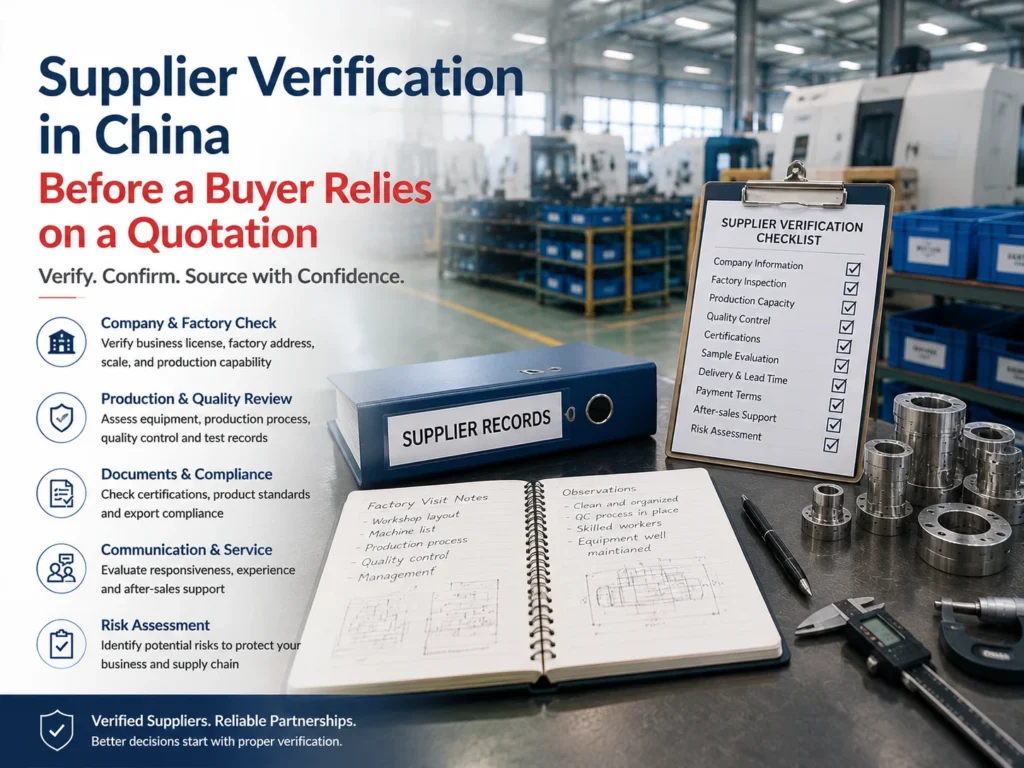
Supplier Verification in China Before a Buyer Relies on a Quotation
Supplier verification is a reality check before samples, deposits or production follow-up. We review company records, supplier statements, product range, address clues, certificate fit and visible signs that a supplier may be a factory, trader, assembler or project coordinator.
Registration, age, address
Factory, trader, assembler
Range, equipment, samples, certificates
Risk notes and next questions
Buyer Summary
Verification helps buyers avoid relying only on a sales message
A supplier can send a polished catalog, quick quotation and confident answer before anyone checks the company behind the message. We start with the small cross-checks buyers often skip: does the Chinese company name match the quote, does the visit address match the place where goods would ship, does the product line look close to the item being quoted, and is the certificate for this model or only for a similar one?
The result is not a green stamp. It is a working note. One part may come from registration records, another from supplier files, another from photos or a short visit. Sales claims are kept in their own bucket until there is proof. If the decision still needs a sample, factory audit, lab test or buyer approval, that stays visible in the note.
Useful when
- You found a supplier online and want a basic check before paying a sample fee or deposit.
- The supplier says it is a factory, but the product range, address or technical answers feel unclear.
- You need to know whether a certificate, export claim or workshop photo fits the actual product under discussion.
Verification or Factory Audit
Supplier verification is a background check before a deeper factory visit
Supplier verification can begin from documents, company names, addresses and supplier replies. A factory audit is more useful when the buyer needs to see the workshop, equipment, warehouse and production flow before a larger decision.
Can partly be done remotely through business registration, company name checks, registered address review, certificate holder checks and supplier background questions.
Is mainly an on-site visit focused on workshop, equipment, visible production capacity, warehouse, quality control area, packing and subcontracting clues.
Verification fits early screening before sample fees or deposits. A factory audit fits larger orders, higher-risk suppliers or claims that need workshop evidence.
Verification produces supplier evidence, mismatches and open questions. A factory audit produces site observations, photos and points for buyer approval.
What We Check
Supplier verification looks at documents, product fit and physical clues together
A single file rarely tells the whole story. Company registration records, supplier documents, quotation details, photos, videos and visit notes each show a different part of the picture. We put them side by side so the buyer can see mismatches earlier.
Registered name, legal status, establishment date, registered address, business scope and whether the name matches quotation, invoice or payment details.
Registered address, office address, factory address, warehouse address and pickup location may be different. The reason should be clear.
Catalog range, showroom photos, sample answers, production photos and supplier replies should be close to the buyer’s product, not scattered across unrelated categories.
We look for signs of factory, trading company, assembler, subcontract coordinator or mixed role instead of accepting a label without questions.
Export claims, test reports, certificates and customer references are checked against model name, holder name, product category, date and visible scope.
Some work may be outsourced: plating, molding, electronic boards, packing, software setup or final assembly. Outsourcing can be normal, but the buyer should know which part is outside the supplier’s direct control.
Document Review
Company records are useful, but they need to be read with product questions
A registration record is a starting file, not a capacity report. It may give the official name, registration date and address. It will not tell us whether the supplier has enough workers for a rush order, whether the mold is owned or borrowed, or whether the model in the quotation is actually made at the address shown to the buyer.
Name and payment consistency
The company name on registration records, quotation, proforma invoice, bank details and email signature should be compared. A mismatch may have a harmless reason, but it should not be ignored.
Establishment date and scope
A new company is not automatically bad, and an older company is not automatically safe. The date and business scope simply add context to supplier history and product range.
Address trail
Registered address, production address and sample pickup address can differ. We ask which address handles sales, production, warehouse work, packing or shipment handover.
Document owner
For certificates and test reports, we check whether the holder name and product model match the supplier and the exact item being quoted.
Factory or Trading Company
The practical question is who controls the product and the change requests
Some buyers ask only, “Are they a factory?” A better question is more specific: who makes the key component, who controls final assembly, who can approve a material change, who owns the mold, who arranges packing, and who responds if bulk goods differ from the accepted sample?
- Factory signs. Narrower product range, production photos tied to the product, equipment that matches the process, test benches, material storage and staff who can answer technical questions.
- Trading company signs. Broad product range, polished catalog across unrelated items, quick quotation collection, limited workshop details and answers that need to be forwarded to another company.
- Assembler signs. The supplier controls assembly, packing and final tests while motors, boards, cartridges, locks, lenses or molded parts come from outside suppliers.
- Coordinator signs. One company may manage several workshops for a project. That can work, but the buyer should know which supplier handles each part.
Certificate Check
Certificates need to match the product, model and holder name
A certificate can look convincing and still be weak for the buyer’s order. The model on the document may be different. The holder may be another company. The report may cover only one component, not the finished product. The date may be old. The buyer’s destination market may require a different test or a laboratory result arranged by the buyer.
Our role is to compare the certificate or test report against the actual inquiry. For a smart lock, the model, electronic module, app system and market requirement may matter. For an electrical item, voltage, plug, label and safety scope need attention. For a machine, CE-style documents do not answer whether the supplier has tested the buyer’s product at the promised speed.
Certificate notes may include
- Holder name and supplier name
- Product name, model and covered variants
- Issue date and issuing organization
- Visible scope and missing product details
- Whether the buyer’s market asks for more testing
- Questions to send back to the supplier
Visit Option
A supplier visit can add useful photos, but only when the checklist is clear
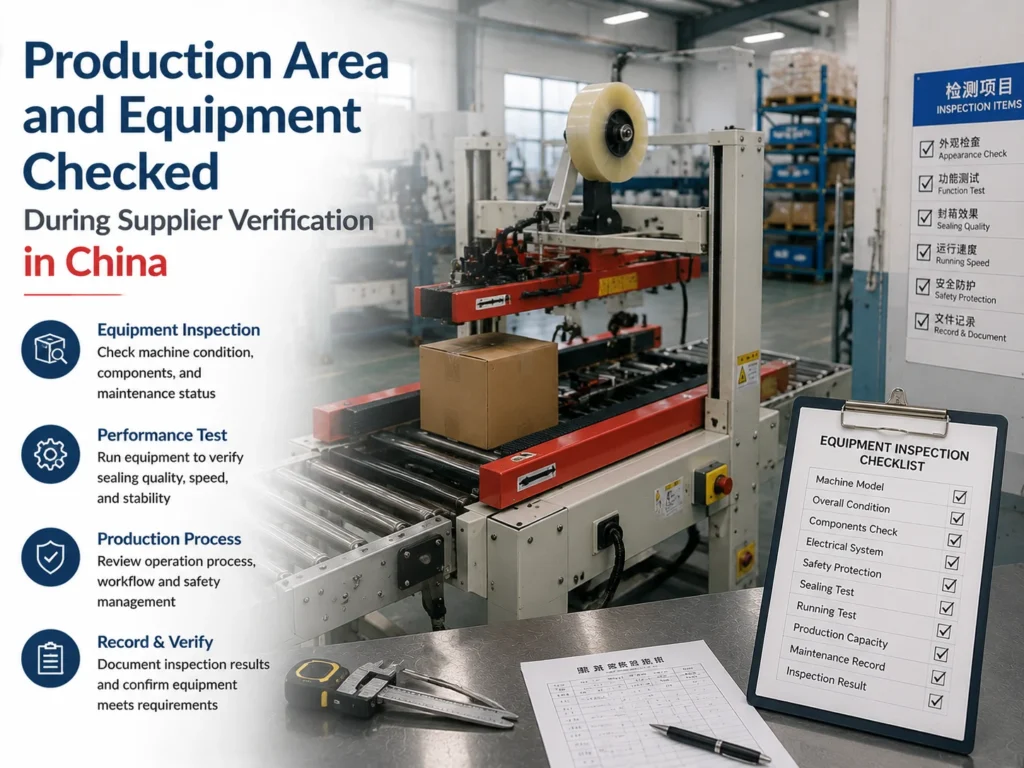
Not every verification needs travel. Some early checks can be done with registration records, supplier documents, video calls, sample photos and quotation questions. A visit becomes useful when the buyer needs visible evidence from an office, workshop, warehouse, packing area or production line.
Office or showroom signs
Company name, product display, sample area, staff answers, order records if shown and whether the products match the buyer’s inquiry.
Workshop signs
Equipment, assembly benches, test area, raw materials, semi-finished goods, finished goods and whether the visible process matches the product.
Warehouse and packing
Cartons, labels, pallets, packing material, stock condition, carton marks and whether export packing is being handled in-house.
Visit limits
A short visit records what is visible on that day. It is not the same as a formal management system audit or full technical audit.
Buyer Input
The check is better when the buyer sends the supplier file first
Supplier verification is more useful when we know what decision the buyer is trying to make. A sample order needs different checks from a large deposit. A repeat order with a known supplier needs different questions from a supplier found yesterday.
Supplier information
Company name in English or Chinese, store link or company profile link, contact person, quotation, invoice, bank details if already received and supplier address.
Product information
Product photo, model, target quantity, destination market, certificate request, sample status, OEM change and the main reason the supplier is being checked.
Known concerns
Different company names, unclear address, very low price, certificate doubt, copied photos, delayed sample, changed payment details or vague technical answers.
Verification Notes
The result should show evidence, mismatches and buyer decisions separately
A useful supplier check is not just a pass or fail label. It should show what was checked, where the information came from, which points do not match, which claims need more proof and which decision still belongs to the buyer.
Company registration, supplier documents, quotation, address details, certificate files, product photos, communication records and visit photos when applicable.
Name, product range, address explanation, model details, certificate holder, sample version or production photos that line up with the buyer’s request.
The note may flag a supplier role that is still fuzzy, a certificate with no matching model, an address not yet confirmed for production, thin equipment photos, outsourced processing or quotation lines the supplier has avoided.
For one file the right move may be a sample. For another it may be a video call, certificate question, factory visit, revised quotation, production check or outside review. The weak point decides the order.
Service Limits
Supplier verification reduces blind trust; it does not remove commercial risk
A supplier may pass basic checks and still make mistakes later. Sample changes, material substitutions, production delays, packing problems and shipment disputes can happen after verification. That is why supplier verification should connect to sample control, production follow-up and inspection planning when the order has real value.
We also separate sourcing checks from legal and technical responsibility. We do not replace a lawyer, certified auditor, laboratory, engineer or freight forwarder. If the buyer’s market requires formal compliance work, that work should be arranged before shipment or sale.
Verification cannot promise
- Every future shipment will match the sample
- The supplier owns every workshop or process
- The certificate covers every buyer market
- The quoted price includes every hidden cost
- The buyer no longer needs samples or inspection
FAQ
Questions buyers ask about China supplier verification
Can verification prove that a supplier has no risk?
No. It can catch mismatched names, unclear addresses, thin product proof, certificate gaps and weak supplier answers. It cannot predict every production problem or commercial dispute.
How do you distinguish a factory from a trading company?
We compare registration details, product range, workshop information, equipment photos, staff answers, sample handling, quotation knowledge and whether technical questions are answered directly or forwarded elsewhere.
Can certificates be checked against the actual product?
Yes, at a practical level. We compare holder name, model, product category, visible scope and date. If the buyer needs formal compliance approval, a qualified laboratory or compliance specialist should be involved.
Does company registration show production capacity?
No. It gives official company details such as name, status, date and address. Capacity needs other evidence such as workshop photos, equipment, production records, visit notes or a factory audit.
What evidence is included in the verification notes?
Depending on scope, notes may include registration details, address comparison, supplier role comments, product range review, certificate comments, photo records, quotation issues and suggested follow-up questions.
When is a factory audit the better choice?
If the buyer is close to a larger order and the worry is inside the workshop, a basic verification note is too thin. That is when we look at a factory audit: machines, production flow, quality checks, warehouse condition, testing area, packing process and records the supplier is willing to show.
Send the supplier file you want checked