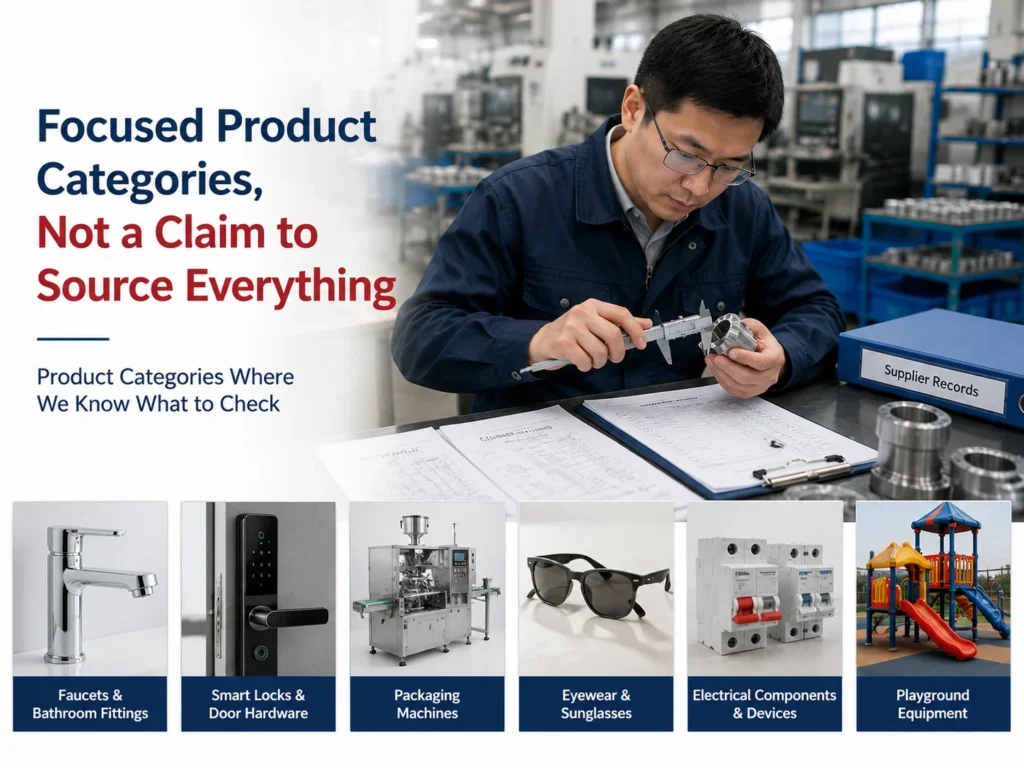
Product Categories Where We Know What to Check
A buyer can search almost any Chinese product online. The harder part is knowing which specification changes the price, which sample detail may not carry into mass production, and which inspection point should be confirmed before shipment.
Wenzhou coordination
Building, equipment, consumer, project
Specification and supplier comparison
Importers with real product details
Quick Answer
We focus on categories where supplier claims need product-level checking
ALF Supply does not present itself as a buyer for every possible product in China. Some categories need a different level of technical review, safety knowledge, laboratory testing, installation planning or after-sales support. If a product is outside our practical range, we would rather say that early than collect quotations we cannot read properly.
A faucet quotation can move when the valve cartridge changes. A smart lock price is different if the lock body, app system or fingerprint module changes. A packaging machine quote is not ready until the supplier has checked the buyer’s real pouch, carton or bottle. The same pattern appears in eyewear, buttons, electrical items and playground projects: the catalog name is only the start.
Before Sending a Request
- Send the product photo, drawing, target quantity and destination market if available.
- Tell us which details are already fixed and which details can still change.
- Share old supplier problems if you have them; they often point to the first checks we should make.
Industry Groups
Four sourcing groups we use to keep product work organized
The categories below are grouped by how buyers usually make decisions. A faucet buyer thinks about material, finish and leakage. A machine buyer thinks about speed, voltage and test material. A playground project buyer thinks about space, safety, installation and container loading. Mixing all of them into one product list would hide the important checks.
Home & Building Products
These products often need material confirmation, surface finish checks, dimension matching, accessories, packaging and market requirements. A small change in valve, lock body, plug, cable, coating or carton can change both price and risk.
Industrial Equipment
Machine and equipment sourcing needs parameter review before price comparison. A supplier may quote a machine speed based on a smaller product, a different film, a stable air source or a voltage that does not match the buyer’s site.
Consumer Products
Eyewear and buttons need close attention to materials, color, finish, logo method, packing and market testing. A good sample is useful, but the buyer still needs to know whether bulk production will keep the same color and finish.
Commercial Projects
Project products are not only unit purchases. Playground equipment requires site dimensions, age range, indoor or outdoor use, structure, safety requirements, installation planning, packing volume and loading plan.
Electrical product or electrical equipment?
Choose the electrical route by how the buyer will use the item.
If you need plug type, voltage, label, certificate model, manual and retail packing checks, use Electrical Product Sourcing. If you need control cabinets, component lists, drawings, wiring labels, industrial test records or crate packing, use Electrical Equipment Sourcing.
What We Check
Different products create different questions before supplier comparison
We do not use one checklist for every category. A faucet quotation is not checked the same way as a packaging machine quotation. Even within the same category, the buyer’s market and intended use can change the questions.
Brass, stainless steel or zinc alloy body; cartridge brand; salt spray requirement; plating; hose and accessory set; leakage test; logo and carton packing.
Lock body size, door thickness, opening direction, TTLock or Tuya use, Bluetooth or Wi-Fi, fingerprint module, battery, emergency power, backup key and after-sales handling.
Product size and weight, packing material, target speed, voltage and frequency, air source, automation level, test-run requirement, spare parts and export wooden crate.
Frame material, lens type, hinge, logo method, color, packing, MOQ, market testing and whether the supplier can keep the same finish in bulk production.
Resin, metal, shell or wood material; size; holes; color; surface effect; color difference; logo; garment accessory matching and packing.
Site size, age range, indoor or outdoor use, structure, materials, safety requirement, installation plan, foundation, packing volume and container plan.
Supplier Screening
The right supplier depends on the product, not only the price
A buyer may receive three quotations for what looks like the same product. The first may be a factory that makes the core component. The second may be a trading company that is faster at communication. The third may be an assembler that buys several parts from outside workshops. None of those roles is automatically good or bad, but the buyer should know which role each supplier is playing.
- Product match. We look for suppliers whose normal products are close to the buyer’s requirement, not only companies that reply quickly.
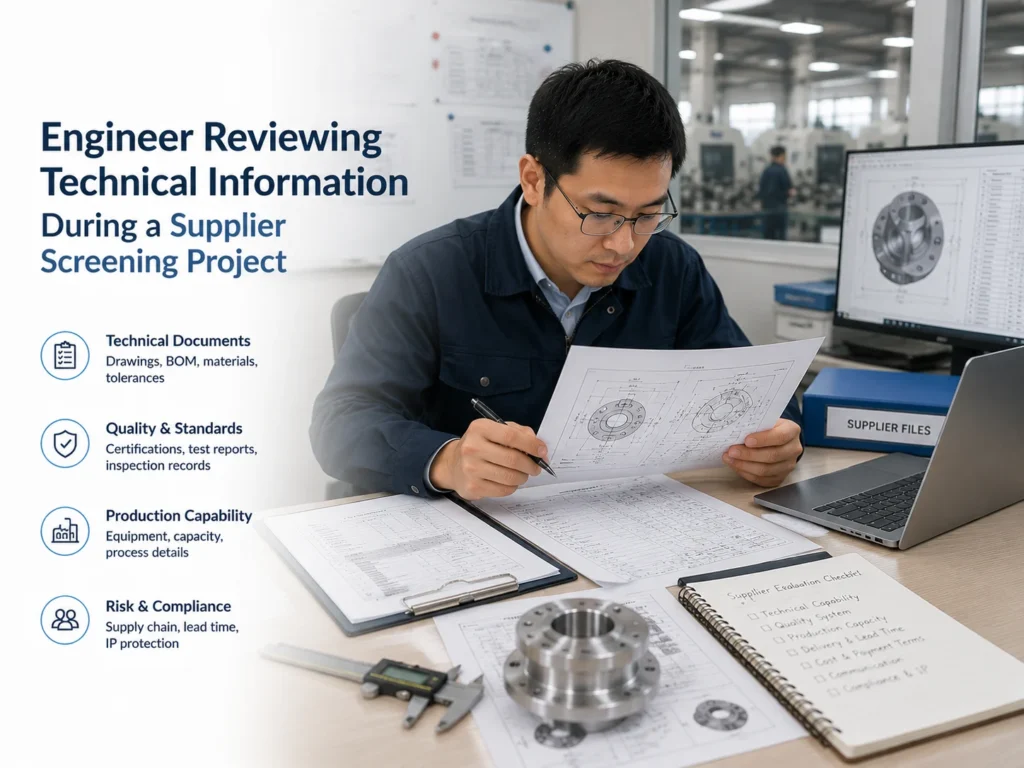
- Specification reading. We ask about the details that change cost, safety, performance, packing or inspection.
- Sample control. We record what sample version was checked and which details must not change in mass production.
- Risk notes. We flag certificate mismatch, vague material claims, unclear packing, missing accessories or production capacity that looks thin.
Buyer Preparation
Information that helps us judge whether a category fits
A short product name is rarely enough. One buyer says “smart lock” and means a Tuya Wi-Fi model for a 45 mm door. Another means a Bluetooth hotel lock with emergency power and backup keys. “Faucet” may mean brass, stainless steel or zinc alloy. “Packing machine” may mean different speeds, films and voltages. Those details should appear before suppliers begin quoting.
Product reference
Photos, drawings, links, samples, old invoices or rejected quotations help us understand what the buyer actually wants to source.
Use and market
Destination country, use case, voltage, safety concern, market testing and retail or project requirements affect supplier selection.
Quantity and budget
Target quantity, expected order rhythm and budget range help filter out suppliers whose MOQ or production setup does not fit.
Past problems
Wrong material, weak cartons, color difference, delayed samples or unclear certificates can tell us where to check first.
Category Limits
Some requests need a different specialist before we quote the work
We may decline or pause a category when the project depends on medical claims, regulated safety systems, heavy engineering, chemical formulas, food contact testing or installation responsibility that cannot be checked through normal sourcing follow-up. In those cases, the buyer may need a laboratory, licensed engineer, compliance consultant or specialist importer before supplier comparison begins.
This is not a weakness in the service. It is part of doing the work honestly. A supplier can send attractive photos and a quick price, but if the buyer needs legal compliance, certified testing or engineering responsibility, those requirements should be handled before the order moves forward.
We are usually careful with
- Products with medical or health claims
- Items needing formal laboratory testing before sale
- Complex machines without clear technical drawings
- Installation projects without local site information
- Requests based only on the lowest possible price
FAQ
Questions buyers ask before choosing a sourcing category
Can you help if my product is not listed here?
You can still send the product details. We will first decide whether the category is close enough to our supplier experience. If it is not, we will say so before starting supplier search.
Why not source every product from China?
Different products need different checks. Some require engineers, laboratory testing, formal compliance review or installation responsibility. A sourcing service should not pretend every category can be handled the same way.
Which category is strongest for Wenzhou coordination?
Wenzhou is useful for nearby visits, sample collection and supplier communication in selected categories such as locks, eyewear, buttons, electrical items and some building products. Other categories may be coordinated through suppliers in different manufacturing regions.
Can you compare suppliers from different cities?
Yes, if the product details are clear enough. We can compare quotation, supplier role, sample plan, production timing and inspection needs even when suppliers are not all in the same region.
Do you choose the final supplier for the buyer?
No. We prepare the comparison and point out visible risks. The buyer still approves the supplier, price, payment terms, order quantity and final product requirement.
What if two suppliers quote very different prices?
We check whether they are quoting the same material, size, accessories, packing, testing, sample terms, warranty and delivery timing. A lower price may be valid, or it may simply leave out important details.
Send the product you want to source