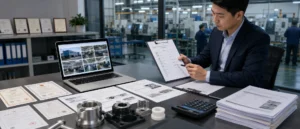
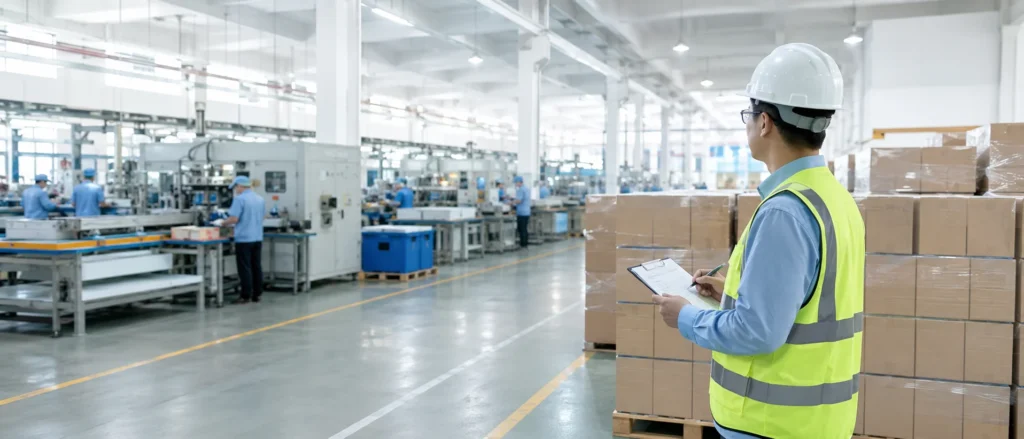
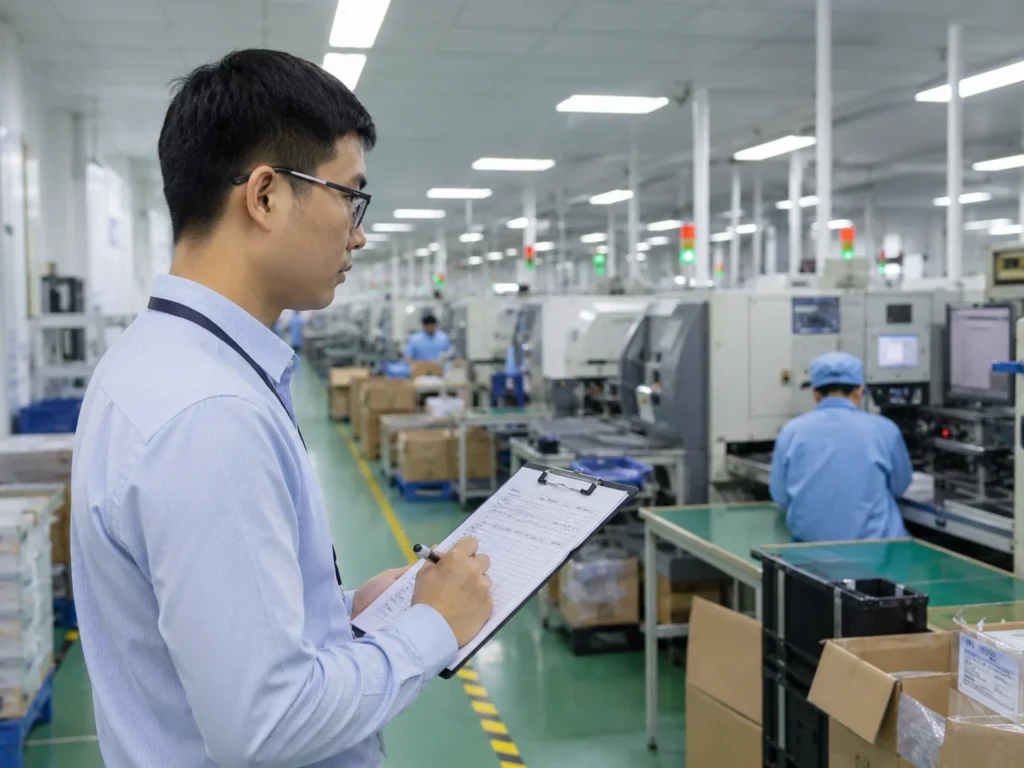
A polished showroom can make a supplier look convincing for an hour. It does not tell you who owns the equipment, where the quoted product is made or how the factory handles a rejected batch. A useful audit follows evidence from the company entrance to the packing area. It also records what the visitor could not confirm.
The checklist should match the purchasing decision. Before a deposit, the main question may be whether the supplier is a real manufacturer with suitable capability. Before a large repeat order, the buyer may care more about capacity, change control and previous quality records. Write that decision at the top of the audit brief.
Prepare the audit before anyone enters the factory
Begin with the supplier’s Chinese legal name, quotation, business licence, bank details, factory address and main contact. Add product drawings, required standards, sample status and expected order quantity. If a sales company and factory are different legal entities, ask for the relationship in writing.
Send a short agenda, but do not give the supplier a script for every photo. Ask to see the processes connected with the quoted product, current production records, material storage, quality area, rejected goods and packing. When a critical process is outsourced, request the subcontractor name and the way incoming work is checked.
A product-specific checklist works better than a long generic form. A faucet project should examine casting or machining sources, cartridge control, finish samples and leak testing. A smart-lock audit should cover mortise versions, electronics assembly, firmware records and function testing. Packaging machinery calls for electrical control, assembly space, trial-run capability and export crating.
Confirm the company and location first
Photograph the exterior sign and note the visit address. Compare the name at reception with the licence and quotation. A mismatch does not always mean fraud; Chinese groups often use separate sales and manufacturing companies. However, the supplier should explain the arrangement clearly, including who will receive payment and who carries product responsibility.
Ask which areas are rented and which belong to the company. Note whether another business shares the floor. Check that employees, internal documents and product labels use a consistent company identity. This practical identity work complements a separate supplier verification check, which can be completed before travel.
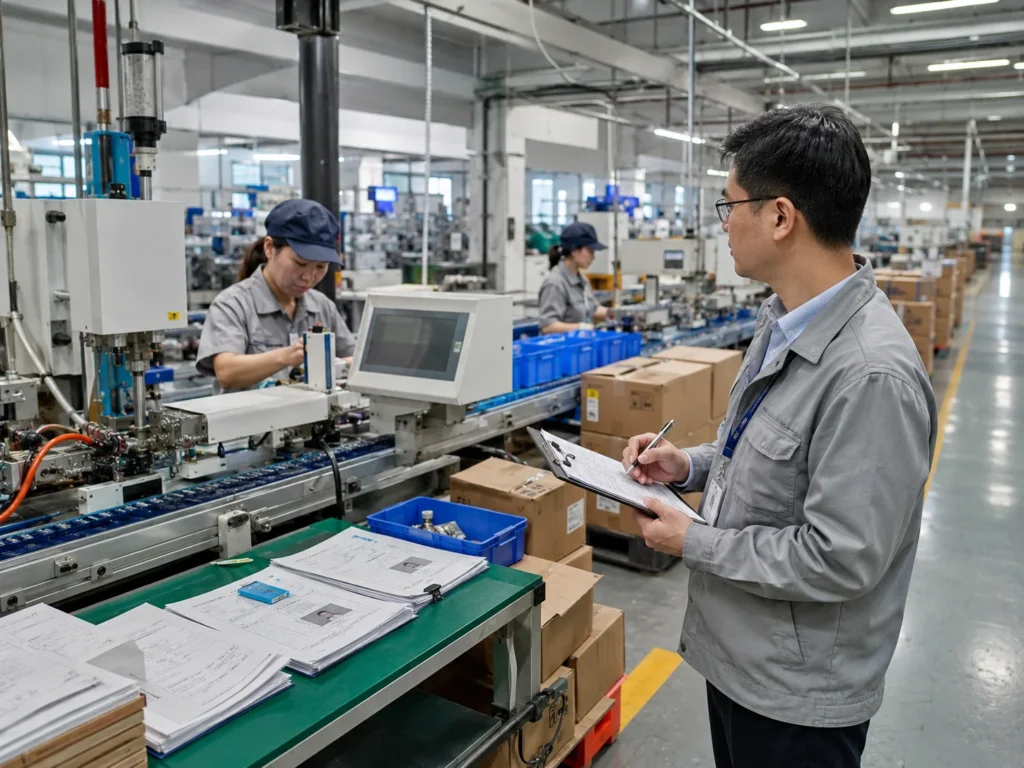
Walk the production route in order
Start where incoming materials arrive. Look for supplier labels, batch identification and a place for incoming checks. Then follow the product through machining, finishing, assembly, testing and packing. The route should make practical sense. Large gaps often indicate outsourced work or a process the host does not want to show.
Do not count machines without context. Record the machine type, visible condition, product being run and whether an operator can explain it. A row of idle equipment may have less value than two well-maintained machines supported by clear work instructions. Equally, busy lines do not prove that the factory has room for your order.
Ask to see a current work order. Compare its model, quantity and process stage with the goods on the floor. Check how workers identify approved samples and revisions. When several similar versions are produced together, look for physical separation or clear labels.
Test capacity claims with simple arithmetic
A salesperson may quote monthly capacity as a round number. Break it down. Count the machines that can actually make your model, then note the normal shifts and output from each shift. Next, find the slowest operation. Painting, assembly or final testing may limit the whole line even when earlier machines have spare time. Ask about the current order book and planned shutdowns as well.
Capacity should relate to your product, not the entire factory. A plant may make 100,000 simple items each month but struggle with 5,000 customised units that need extra finishing or testing. Also ask what happens during peak season. Overtime and temporary labour can increase output, yet they may require closer supervision.
Read the quality system through working records
Certificates matter, but daily records reveal whether the system is active. Ask for an incoming inspection record, an in-process check, a final inspection report and one recent nonconformance record. Names and dates should make sense. The factory should be able to explain what happened after a failed result.
Look at measuring and test equipment. Check identification labels and calibration status where calibration is relevant. Ask an operator to describe the test rather than relying only on the quality manager. Bring one demanding point from the buyer’s specification into the discussion. Ask the operator to show the fixture, method and pass limit that would be used for that point. If the setup is not available, record how and where the factory plans to obtain the result.
ISO includes ISO 9001 in its overview of widely used standards. At the factory, read the certificate closely instead of photographing it from the reception wall. Match the legal name and address, note the scope and expiry details, and verify the issuer when needed. After that, choose a recent order and ask staff to retrieve its inspection record. The paperwork should lead back to real checks on the workshop floor.
Ask for one real example of a defect. A factory that can show the problem, containment, correction and prevention gives more useful evidence than a factory claiming it never has defects.
Find out what happens outside the building
Outsourcing is common and does not automatically make a supplier unsuitable. Plating, heat treatment, mould making, circuit-board assembly and specialised testing may be handled elsewhere. The important question is whether the quoted supplier controls that work.
List each outsourced step. Ask how subcontractors are approved, how specifications are transferred and what is checked when parts return. If the outside process carries a high quality or compliance risk, the buyer may need a separate visit, test report or incoming inspection record.
Inspect storage, traceability and packing
In the material warehouse, look for labels, batch separation and protection from moisture, dust or damage. In the finished-goods area, compare carton labels with work orders. Unmarked stock, mixed models and open cartons near shipment deserve questions.
Then move to packing. Ask for the approved carton, accessory list, label artwork and packing instruction. For machines, inspect the method used to fix equipment inside the wooden case. For finished hardware, check surface protection and whether loose parts can scratch the product.
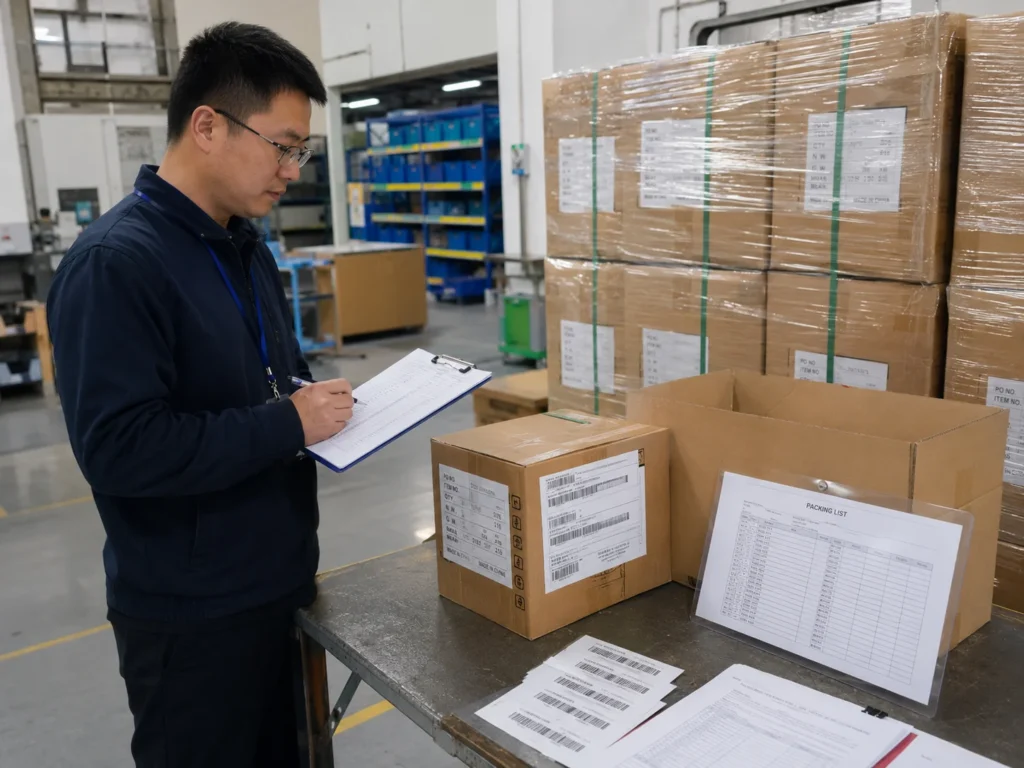
Make every photo answer a question
A machine photo without a caption proves little. Number the images and connect each one to the checklist. Include the location, process and observation. When photography is restricted, write down the restriction and collect another form of evidence where possible.
Useful records include the entrance sign, relevant equipment, current work, test setup, material labels, rejected-goods area, finished stock and packing method. Avoid photographing employee faces or confidential customer information unless permission is clear.
Know what one audit cannot prove
An audit is a snapshot. It cannot guarantee future quality, capacity or delivery. It may not reveal every subcontractor, financial problem or compliance issue. A general sourcing visit also differs from a formal social, environmental or quality-system audit performed against a defined standard.
Use the result to decide the next control. A promising factory may still need an approved sample. A weak material-control finding may call for an early production check. A high-risk order may require laboratory testing and a pre-shipment quality inspection. If production has already started, connect corrective actions with production follow-up.
Factory audit checklist summary
| Area | Evidence to collect | Question raised by weak evidence |
|---|---|---|
| Identity | Licence, sign, address and payment entity | Who contracts, manufactures and receives funds? |
| Production | Relevant equipment, work orders and process route | Which steps are actually performed here? |
| Capacity | Machines, shifts, output and current workload | Can the quoted lead time be supported? |
| Quality | Inspection, calibration and defect records | How are failures contained and corrected? |
| Subcontracting | Outside processes and incoming controls | Who controls the highest-risk external step? |
| Warehouse | Batch labels, separation and storage condition | Can material and finished goods be traced? |
| Packing | Approved carton, accessories and export protection | Will the shipment match the order file? |
Questions buyers often ask after a factory audit
Is a factory audit the same as supplier verification?
No. Verification establishes who the supplier is and whether its documents and payment details fit together. The visit answers a different set of questions: what is made at the address, how work moves through the building and what happens before goods reach the export carton.
Can a current ISO 9001 certificate replace the factory visit?
Not when the order carries meaningful product or delivery risk. First confirm that the certificate belongs to the factory you are considering. During the visit, ask staff to retrieve live records for incoming materials, production checks and rejected goods. Those records show how the system operates on an ordinary working day.
Should a factory fail if it outsources production?
Not automatically. Record the outsourced step and examine how the supplier approves, instructs and checks the subcontractor.
When should the factory audit take place?
For a new high-value supplier, complete it before a substantial deposit. Repeat or targeted audits may be useful after major changes, quality failures or long gaps between orders.
Can an audit guarantee shipment quality?
No. An audit evaluates capability and visible controls at a point in time. Approved samples, production monitoring, testing and final inspection manage different risks.