

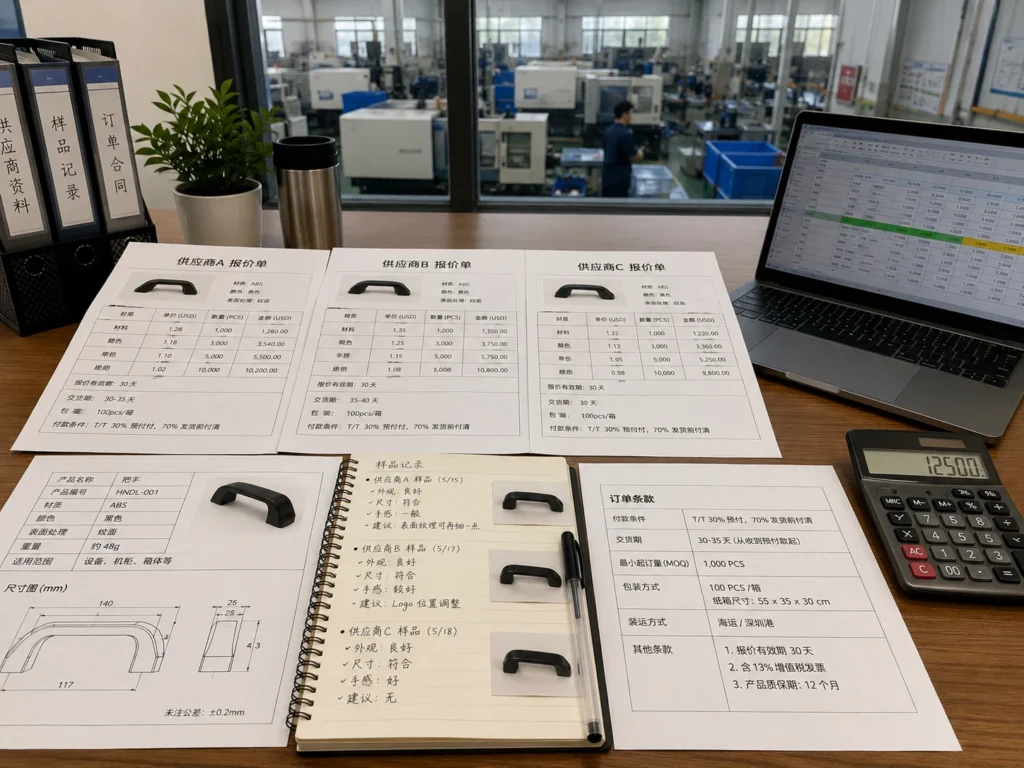
Three factories can quote a product that looks identical in a catalogue and still be pricing three different orders. One includes export cartons. Another uses a lighter component. The third quotes EXW while the others quote FOB. If you sort those offers by unit price, the spreadsheet gives a clean answer to the wrong question.
A sound comparison does not begin with negotiation. It begins by removing uncertainty. Each supplier should receive the same requirement and return the same fields. Only then can you see whether a price gap comes from efficiency, a technical difference or an omission.
Send every supplier the same RFQ brief
Informal enquiries create informal prices. A message that says “please quote your best price for 1,000 pieces” leaves the supplier to choose the material, packing and commercial assumptions. The fastest responder may quote stock quality. A cautious factory may include export-ready packing and appear expensive.
Prepare one request for quotation, even if it is only two pages. Give the product a reference number. Add drawings or clear photos where dimensions matter. State the destination market, quantity, intended use and required compliance. If you have an approved sample, identify its version and date.
At minimum, the brief should cover:
- Product dimensions, material and finish.
- Critical components, acceptable brands or performance levels.
- Order quantity and any expected repeat volume.
- Logo, label, manual and retail-packing requirements.
- Target market and known testing or certification needs.
- Requested Incoterm and named port or place.
- Sample timing, production target and desired shipment date.
If the product is still under development, say so. Ask suppliers to separate confirmed fields from suggestions. That keeps an engineering alternative from quietly turning into the quoted standard.
Check the physical product before comparing unit prices
Product names hide cost differences. A “brass faucet” quote may use a different body weight, cartridge, aerator or hose set. A smart lock price can change with the mortise, cylinder, app platform and number of access cards. On a packaging machine, voltage, electrical brand, conveyor dimensions and spare parts affect both price and installation.
Break the product into priced decisions. Ask for the actual material grade rather than “high quality material.” Record thickness, weight or component model when they matter. If the supplier proposes an alternative, keep it in a separate column. Do not overwrite your required specification.

Give the accessory set its own row. Factories do not always list every key, hose, cable, fastener or adapter in the headline price. These small items rarely attract attention during negotiation. However, one missing part can stop installation at the customer’s site. Ask the supplier to lay out the complete set and photograph it before the packing list is approved.
Next, review the sample rule. Will the bulk order follow the quoted specification, the supplier’s standard sample or the buyer-approved sample? Our sample management process keeps revision notes and approval evidence together so that the final sample does not become a vague visual reference.
Put commercial terms on the same basis
A product can match perfectly while the offers remain commercially different. Standardise these fields before ranking suppliers.
Quantity and MOQ
Ask each supplier to price the same order volume. Add quantity breaks only for volumes you might genuinely buy. For instance, a buyer expecting to start near 1,000 units may also request prices at 500 and 3,000 units. That shows the cost movement around the likely order. A long ladder of unrealistic quantities usually distracts from the decision.
MOQ also has layers. The factory may accept 1,000 units in total but require 500 units per colour. Printed boxes may have a separate minimum. A component maker may set another threshold. Record total MOQ, per-model MOQ and packaging MOQ separately.
EXW, FOB and the named location
Do not place EXW Shanghai beside FOB Ningbo and call the prices comparable. EXW leaves more transport and export work to the buyer. FOB includes a different set of seller responsibilities. The named port or place also matters.
The U.S. Department of Commerce provides a useful, non-commercial overview in its official guide to Incoterms. Use the agreed rule and location in the quotation and purchase order. If your team is unsure about the right term, ask your freight forwarder before accepting the offer.
Payment terms
A 30% deposit with 70% before shipment is not financially identical to a larger deposit or full advance payment. Look beyond the percentages. Define what triggers the balance: completion notice, passed inspection, shipping documents or another event. Before sending money to a new supplier, complete the checks in our guide to verifying a Chinese supplier before paying a deposit.
Tooling, samples and one-time charges
Do not bury one-time development expenses inside the piece price. Show each mould, print plate or production fixture on a separate line. The quotation should also name the tooling owner and its storage location. If repair or upkeep will be billed later, record that rule now. Handle samples in the same practical way: separate the sample itself, any custom work and the courier charge. When the supplier offers to credit a sample payment against the order, write down the quantity or deposit that activates the credit.
Lead time and quotation validity
“About 30 days” needs a starting point. Does the clock begin when the deposit arrives, when artwork is approved or when the final sample is signed off? Also ask whether the estimate reflects current factory capacity. Raw-material prices and currency conditions can change, so note how long the quotation remains valid.
A useful quotation lets another person reconstruct the deal. They should understand what is being made, what is included, when payment is due and which costs remain outside the offer.
Compare packing as part of the product
Packing is not a final-week decoration. It affects cost, carton size, freight, breakage risk and retail readiness. List the inner protection, unit box, master carton, carton marks and pallet or crate. Ask for carton dimensions, gross weight and units per carton.
For machinery, check whether the quote includes an export wooden case, moisture protection and internal fixing. For faucets, confirm protective bags, dividers and hose placement. For smart locks, make sure accessories cannot move against the finished surface. A lower price loses its advantage quickly if replacement parts or damaged cartons must be airfreighted later.
Build a comparable order cost, not a unit-price ranking
Once the fields match, calculate the cost of the order you expect to place. Start with goods value. Add tooling, custom packing, domestic charges that are not covered by the Incoterm, inspection, testing and other known project expenses. Freight and import charges may require a separate estimate from your forwarder or customs adviser.
Keep uncertain items visible. If laboratory testing has not been quoted, do not enter zero. Mark it “pending.” Zero means no cost; pending means a decision is still open.
| Comparison field | Supplier A | Supplier B | Supplier C |
|---|---|---|---|
| Unit price | US$8.40 | US$8.05 | US$7.78 |
| Trade term | FOB Ningbo | FOB Ningbo | EXW Wenzhou |
| Required component | Confirmed | Alternative model | Not stated |
| Export carton | Included | Included | Standard carton only |
| Tooling | US$600 | US$950 | Pending |
| Production time | 35 days after sample approval | 30 days after deposit | 25–35 days, start point unclear |
Supplier C appears cheapest, but it is not ready for a price decision. The component, packing upgrade, tooling and EXW handling remain unresolved. Supplier B is comparable only if the alternative component meets the requirement. Supplier A costs more per unit, yet its offer is the easiest to calculate.

What to do after the first comparison
Send each supplier a short list of missing or conflicting fields. Ask for a revised quotation rather than collecting answers across several chat threads. Give the revision a date or version number. When a supplier changes the price, ask which input changed.
Next, narrow the field. There is little value in sampling five factories when two cannot meet the specification. Use the quotation comparison to choose the suppliers worth verifying and sampling. Our supplier verification work looks at company identity and capability questions that a quotation cannot prove by itself.
Finally, carry the confirmed fields into the purchase order, approved sample and inspection checklist. Otherwise, the comparison work disappears as soon as the buyer chooses a factory. During production, production follow-up should refer back to the same record rather than a fresh set of informal promises.
Quotation red flags worth pausing for
- The supplier offers a precise low price but leaves material or component fields blank.
- The bank account belongs to a company that is not explained in the quotation or contract.
- The quote says FOB but does not name a port.
- The supplier refuses to separate tooling from unit cost.
- The lead time is unusually short, yet no one has checked current capacity.
- A certificate is supplied, but the model or manufacturer does not match the quoted goods.
- The sample uses one component while the quotation reserves the right to use an “equivalent.”
- The price changes repeatedly without a corresponding change in quantity, specification or terms.
One red flag does not always disqualify a supplier. It does call for a direct question and a written answer. If the explanation affects the order, put it in the revised quotation.
Questions buyers ask while reviewing quotations
Why do Chinese suppliers quote very different prices for the same product?
The offers may cover different materials, components, packing or trade terms. Production method, current workload and quantity also affect cost. First check the hidden specification fields; then ask about the factory’s pricing logic.
Can I compare EXW and FOB prices directly?
No. The seller’s cost and responsibility differ. Ask for the same Incoterm and named location, or add the missing logistics and export costs before comparing.
What information belongs in a supplier quotation?
Include the product specification, quantity, unit price, trade term, packing, tooling, sample terms, payment, production time, validity and exclusions. Complex products also need component versions and test requirements.
Should I choose the lowest quotation after the fields match?
Price becomes meaningful once the scope matches, but it is still one factor. Check supplier identity, production capability, communication quality, sample result and the cost of a likely failure.
What should I do with blank fields?
Mark them unconfirmed. Ask the supplier to complete the field and issue a revised quotation. Never assume an unstated accessory, test or packing method is included.