
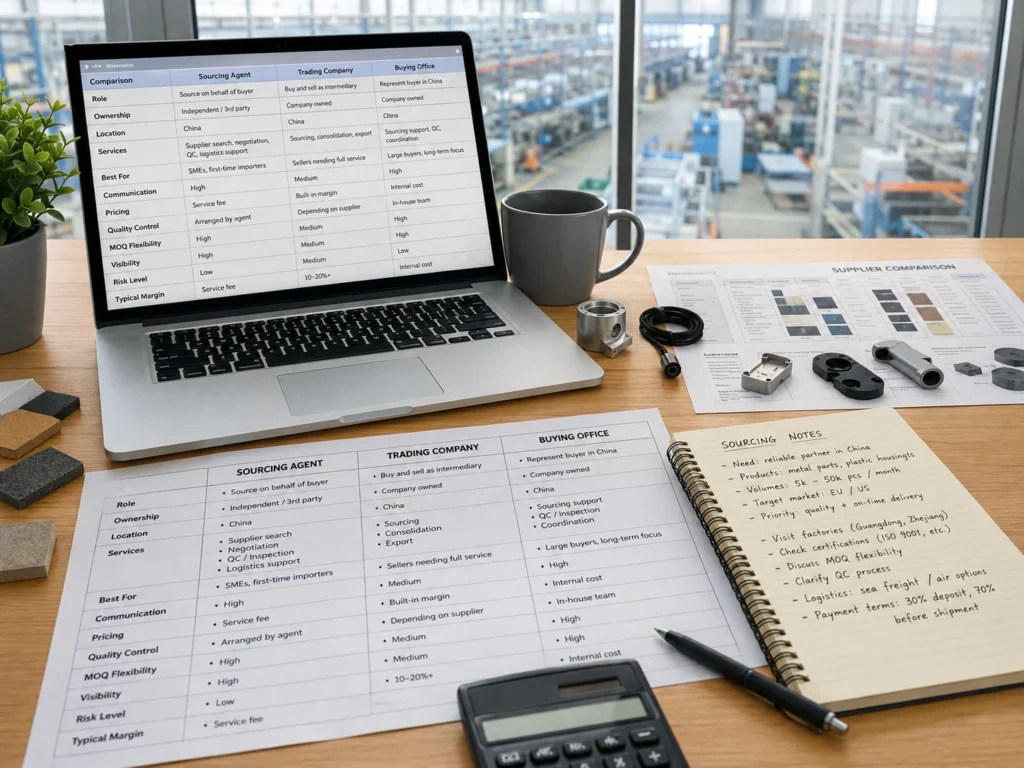
The same supplier search can lead to three very different commercial arrangements. A sourcing agent may introduce the factory and charge for local work. A trading company may sell the goods under its own invoice. A buying office may manage several factories as part of the buyer’s regular operation. The label matters less than the contract, payment path and control behind it.
Before choosing, draw the transaction on paper. Who signs the purchase contract? Who receives the product payment? Does the buyer see the factory quotation? Who owns samples and tooling? The answers show how the arrangement works when an order goes wrong.
The short difference is commercial role
With an agent, the buyer usually pays for local assistance while the chosen factory remains visible in the transaction. A trader takes a different position: its company name appears on the sales offer, and it delivers goods collected or produced through its supply base. A buying office stays involved after one order ends. Its team carries supplier knowledge, calendars and approval records into the next purchasing cycle.
| Question | Sourcing agent | Trading company | Buying office |
|---|---|---|---|
| Typical role | Buyer-side service provider | Commercial seller | Local purchasing operation |
| Factory visibility | Often open, depending on agreement | May remain behind the seller | Usually detailed and ongoing |
| Payment | Service fee plus factory payment, or another disclosed structure | Buyer pays the trading company for goods | Salary, retainer or operating budget plus supplier payments |
| Best fit | Defined projects and buyers wanting supplier choice | Convenient product supply through one seller | Regular multi-supplier purchasing |
These are common patterns, not legal definitions for every company. Some firms combine roles. Therefore, read the agreement and invoice route instead of relying on the name printed on a website.
How a sourcing agent arrangement works
A buyer may hire an agent to find factories, align quotations, arrange samples and follow production. The agent gathers local evidence, but the buyer keeps the final decision. In an open arrangement, factory names and original quotations remain visible.
This structure suits a buyer who wants to build a direct supplier relationship but needs help on the ground. It can also work for a defined task, such as checking an existing supplier or coordinating a difficult sample. Our product sourcing service follows this project-based approach.
The fee deserves careful attention. It may be a fixed project amount, a percentage of order value or a staged charge. Ask whether the agent also receives money from suppliers. Our guide to China sourcing agent fees explains minimum charges, exclusions and commission calculations.

Where an agent can reduce the buyer’s workload
- Factory replies can be translated, questioned and placed in one comparison file before the buyer chooses a candidate.
- The service can be limited to search, samples, verification or order follow-up.
- Factory information may remain visible, supporting a long-term direct relationship.
- The buyer can use separate inspectors or laboratories when independence matters.
Questions and risks
An agent can still have a conflict of interest. A hidden supplier rebate may influence the shortlist. Some agents also collect all payments through their own company, which changes the commercial risk. Ask for the legal name of every payment recipient and clarify who is responsible for product claims.
The agent’s influence also has limits. A service provider cannot guarantee factory performance simply because it sends weekly messages. The purchase order, approved sample and inspection plan still need clear ownership.
How a trading company arrangement works
A trading company issues the product offer in its own commercial role. Behind that offer, one factory might make the complete item, or several workshops might supply different parts. The buyer does not have to coordinate each source separately. Orders, payment questions and mixed cartons return to the same sales counterparty.
This model is useful when the trader knows a product category well, maintains stock or can combine small orders that factories would reject. A capable trading company may also solve problems quickly because it buys regularly from its factories.
Advantages of buying through a trading company
- One company can supply several products on one commercial invoice.
- The trader may accept smaller quantities or mixed models.
- The buyer has one seller to contact when a component or shipment changes.
- Experienced traders can translate vague market requirements into factory instructions.
Questions and risks
The buyer may not know the actual manufacturer or production route. If the trader changes factories, the product can change while the sales contact remains the same. Ask whether factory substitution requires approval. Also confirm whether certificates, test reports and audit records belong to the factory making your order.
Price transparency is different from an agency model. A trader earns through its sales margin, so the original factory price may not be shared. That is not automatically improper. The buyer should judge the delivered specification, service and commercial responsibility rather than demanding a cost breakdown that was never part of the offer.

How a buying office differs from a one-off agent
A buying office earns its value between orders as well as during them. Some importers employ the team directly; others retain a local group under a continuing agreement. On an ordinary week, the staff may chase sample revisions, update a seasonal range, visit a delayed factory and prepare inspection dates. Purchase orders and shipment plans remain part of the same ongoing record.
The model makes sense when the workload is steady enough to occupy people every week. A retailer sourcing across several categories may need recurring factory visits and calendar control. A buyer placing two small orders a year probably does not.
A buying office creates its own management work. The buyer must set authority levels, reporting, data access and approval rules. Local staff should not be able to change a supplier, approve a major deviation or release payment without a defined process.
Advantages of a buying office
- Knowledge of suppliers and product history stays with a regular local team.
- Several factories can be managed under one reporting calendar.
- Staff can follow samples, production and shipment preparation continuously.
- The buyer can build its own procedures instead of renegotiating each task.
Questions and risks
Fixed cost is higher, even when order activity slows. Hiring, supervision, confidentiality and staff turnover also matter. If the office depends too heavily on one local manager, supplier relationships and records may leave with that person.
Do not choose by title alone. Identify the seller, service provider, manufacturer and payment recipient for the actual order.
Compare transparency in the areas that affect your risk
Complete transparency is not always necessary. A buyer purchasing a standard stocked item from a trader may only need a reliable seller and compliant product. A buyer developing custom tooling needs much more visibility because factory changes could affect ownership and repeatability.
Ask these questions before signing:
- Will the factory’s legal name and address be disclosed?
- Who signs the goods contract and issues the invoice?
- Who owns moulds, drawings, artwork and approved samples?
- Can the supplier or factory be changed without written approval?
- Who decides whether goods pass inspection?
- Does any party receive undisclosed commission or rebates?
- Who pays for rework, replacement or reinspection?
The U.S. International Trade Administration advises companies entering China to conduct due diligence and protect intellectual property in its official China market entry guidance. For import buyers, the same practical idea applies: verify the companies that will contract, manufacture, receive payment and hold valuable product information.
Decide who controls samples and inspection
In an agency arrangement, the buyer may approve the sample directly with the factory and appoint an independent inspector. With a trading company, the trader may manage both the factory and correction process. A buying office may run the buyer’s own inspection program.
No structure removes the need for a written product reference. Keep the approved sample, specification, artwork and defect rules under buyer control. If the service provider performs the inspection, understand whether it is reporting to the buyer or approving its own supply decision. For higher-risk orders, use a separate quality inspection arrangement.
Choose the model that matches the order
Choose a sourcing agent when:
You want to compare factories openly, keep supplier choice and purchase local support as a defined service. This often suits new sourcing projects, custom development and buyers building direct factory relationships.
Choose a trading company when:
You value one seller, mixed products, category knowledge or smaller quantities more than direct factory visibility. Judge the trader as the responsible supplier and make factory-change rules clear for custom goods.
Build or retain a buying office when:
You have enough repeat work to justify a regular local team. Set approval authority, reporting standards and data ownership from the beginning.
Some buyers use a mixture. They buy standard accessories from a trader, work directly with a core factory through an agent and maintain local staff for major seasonal programs. The model can change by product risk rather than by company policy.
Questions buyers ask before selecting a China sourcing model
Is a sourcing agent always more transparent than a trading company?
No. Transparency depends on the agreement and behaviour. Ask what information will be disclosed, who receives payments and whether supplier commissions exist.
Is buying from a trading company more expensive?
The trader includes a margin, but direct factory purchasing also creates search, communication, inspection and management costs. Compare the total value and risk, not only the factory unit price.
Can a trading company be the right supplier?
Yes. A strong trader can provide useful category knowledge, small quantities and one point of responsibility. Confirm product control, documentation and factory-change rules.
When does a buying office become worthwhile?
It becomes easier to justify when recurring projects create enough work for a permanent or retained local team. Order frequency and management complexity matter more than one large purchase.
Who should receive the product payment?
Pay only the company named in the agreed contract and verified payment instructions. If an agent, factory and seller use different entities, resolve the relationship before sending funds.