Production Follow-up in China After the Sample Is Approved
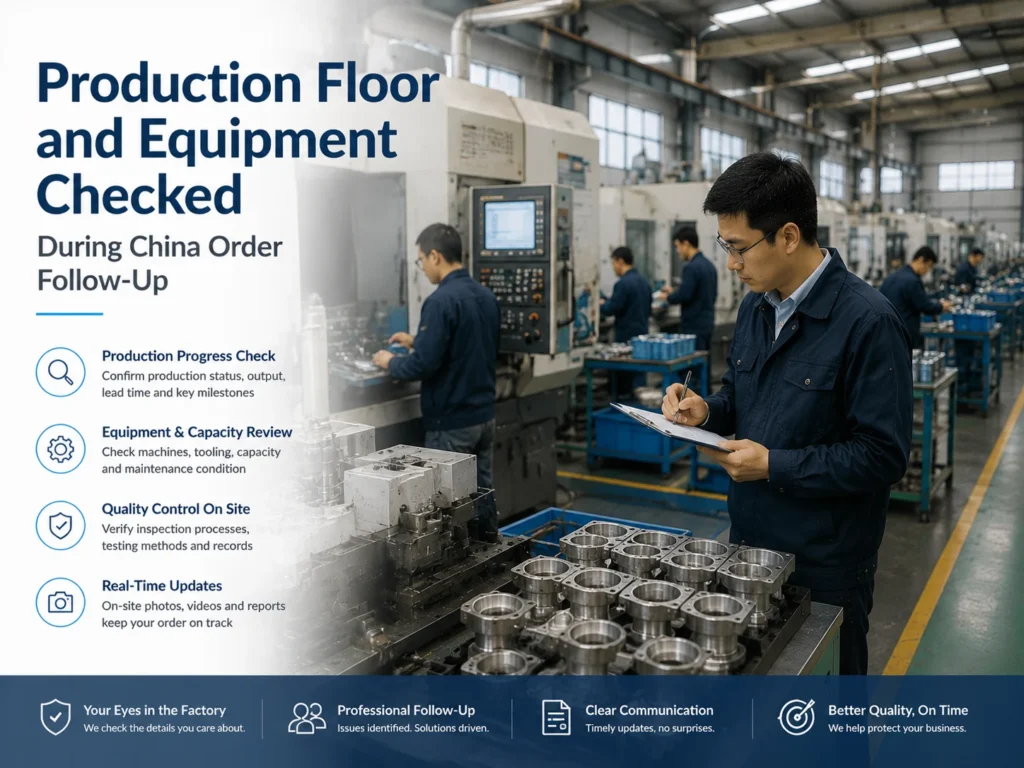
The quiet weeks after a deposit are when small details can drift. We track the order against the accepted sample, supplier schedule, material status, packing plan, inspection timing and open buyer decisions before the goods reach the final week.
Order and sample confirmation
Materials and production photos
Packing, labels, spare parts
Ready, correct, reinspect or hold
Production Board
Follow-up starts by fixing what the factory is supposed to make
Before asking for progress photos, the order file needs to be clear. Which quotation was accepted? Which sample version is the reference? Which packaging artwork is approved? Which accessories, spare parts, labels and carton marks are included? A supplier can say production has started, but that sentence is too thin if the buyer’s accepted details are still scattered across chats.
We build the follow-up around milestones. The aim is not to watch a factory every hour. The aim is to catch missing points early enough to ask for correction: wrong label position, missing spare parts, carton marks not approved, material not ready, test video not scheduled, or inspection booking pushed too close to shipment.
- Order file. Confirm product model, accepted sample, quantity, packing, delivery target, payment terms and inspection plan.
- Milestone calendar. Set expected dates for material preparation, production start, mid-production update, packing confirmation and final inspection.
- Open point list. Keep buyer approvals, supplier replies, correction requests and shipment decisions in one running record.
- Release decision. Before goods leave, separate what is ready, what needs correction, what needs recheck and what still belongs to the buyer.
Follow-up or Final Inspection
Production monitoring runs from order confirmation to finished goods
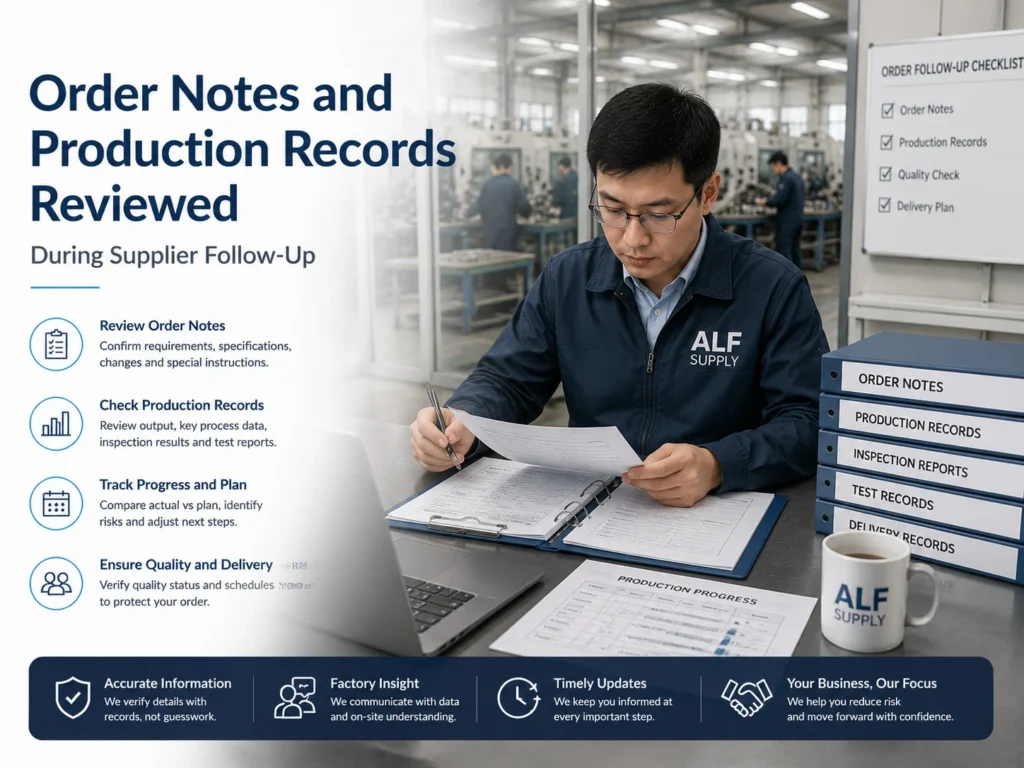
Production follow-up is not a final quality inspection. It tracks the order while there is still time to ask about raw material arrival, production start, mid-production progress, delay warning, packaging preparation and production photos.
Starts after order confirmation and follows material readiness, production start, progress photos, packing preparation, delay signals and inspection booking.
Happens after goods are substantially completed and focuses on sampling, quantity, workmanship, dimensions, function, labels, carton marks and packing.
Follow-up helps catch missing information before the final week. Inspection helps the buyer decide whether finished goods should be released, corrected or rechecked.
Production follow-up can warn about drift, but it does not replace a focused pre-shipment inspection of finished goods.
Order File
The first check is whether the supplier and buyer are using the same order reference
A production delay is easier to handle than a production misunderstanding. Before the factory starts buying materials or arranging workers, we check the details that decide what will be made.
Product name, model, specification, quantity, unit price, Incoterms if agreed, delivery target and payment schedule.
Golden sample date, version number, approved photos, buyer comments and details that must not change in bulk goods.
Inner box, export carton, label, barcode, instruction sheet, spare parts bag, pallet or wooden crate requirement.
Expected completion date, inspection window, test points, packing checks, product photos needed and who approves shipment release.
Artwork not approved, spare parts not final, certificate question, carton mark missing, sample change still under discussion or payment timing not settled.
Milestone Board
Seven production stages need different questions
Production follow-up is useful when the questions change by timing. Asking for finished carton photos before materials are ready is noise. Waiting for carton photos until goods are fully packed is too late.
Order confirmation
Confirm product, quantity, accepted sample, packing, payment schedule, lead time and supplier contact responsible for updates.
Material preparation
Ask whether key materials, components, cartons, labels, motors, locks, cartridges, lenses or packing film are ordered or already in the workshop.
Production start
Request first production photos or short video tied to the buyer’s model, not just a general workshop view from another order.
Mid-production update
Check quantity made, visible finish, components, line progress, defect notes, schedule risk and whether the factory still expects the original finish date.
Packaging confirmation
Review inner box, carton marks, labels, spare parts, manual, pallet plan, wooden crate or other packing details before everything is sealed.
Final inspection booking
Confirm goods quantity, packing status, inspection address, contact person, date window and whether finished goods are ready for a proper check.
Shipment release
After inspection or final review, sort the shipment into release, supplier correction, reinspect, accept with condition or hold for buyer decision.
Decision record
Keep each buyer approval and supplier promise tied to a date, photo, file or message so later changes are easier to trace.
Delay Signals
Delay risk usually appears before the supplier says the order is late
A supplier may avoid saying “delayed” until the problem is already obvious. The early signs are smaller: materials have not arrived, carton artwork is still pending, the first production photo is vague, the factory gives the same update twice, or inspection date keeps moving. We write those signals down instead of waiting for the final week.
Not every warning means the supplier is failing. Some delays are normal after a buyer changes color, packing, logo method or test requirement. The important part is to know which delay came from buyer approval, supplier scheduling, material purchase, tooling, rework or inspection booking.
Signals to ask about
- Material photos not provided after promised date
- Production start photo shows a different model
- Carton artwork still not approved
- Supplier avoids quantity made so far
- Inspection date is pushed close to loading
- Packing list differs from order quantity
Product Examples
Different products need different follow-up photos and questions
A production update is only useful when it shows the right part of the order. For a faucet, carton photos are not enough if the cartridge changed. For a machine, a painted frame photo is not enough if the buyer’s product has not been tested. For a lock, a panel photo is not enough if the lock body is different from the approved sample.
Lock body, panel, app system, battery cover, keys, screws, language, packing, door thickness and function test video.
Body material, cartridge, finish, hose set, leakage test, logo, foam bag, inner box, carton marks and accessory list.
Frame progress, electrical cabinet, motor brand if specified, test material, trial run, spare parts, manual, crate packing and voltage label.
Color consistency, surface finish, hinge or hole details, logo position, packing cards, quantity by color and bulk photos under normal light.
Structure parts, coating, hardware, packing volume, labels, installation pieces, container plan and whether site-specific parts are included.
Before the Final Week
Packing details should be checked before goods are sealed
The final week is a bad time to discover missing labels, weak cartons, wrong spare parts or a packing list that does not match the order. We ask for packing confirmation before everything is closed. The supplier should show the carton, inner packing, labels, marks, accessory bags and any pallets or wooden crates that matter for export.
For some orders, this is where small corrections are still possible. A label can be reprinted, a spare part bag can be added, carton marks can be corrected, or a manual can be inserted before final inspection. If the issue is found after loading, the buyer has fewer choices.
- Carton and label. Check wording, barcode, model, quantity per carton, warning marks and buyer brand requirements.
- Accessory bag. Confirm screws, keys, cables, hoses, spare parts, manuals or installation pieces that should ship with each unit.
- Packing list. Compare order quantity, carton count, gross weight, net weight and product grouping before forwarder handover.
- Inspection readiness. Confirm goods are accessible, mostly packed and available at the inspection address on the agreed date.
Update Records
Production updates should leave a trail the buyer can read later
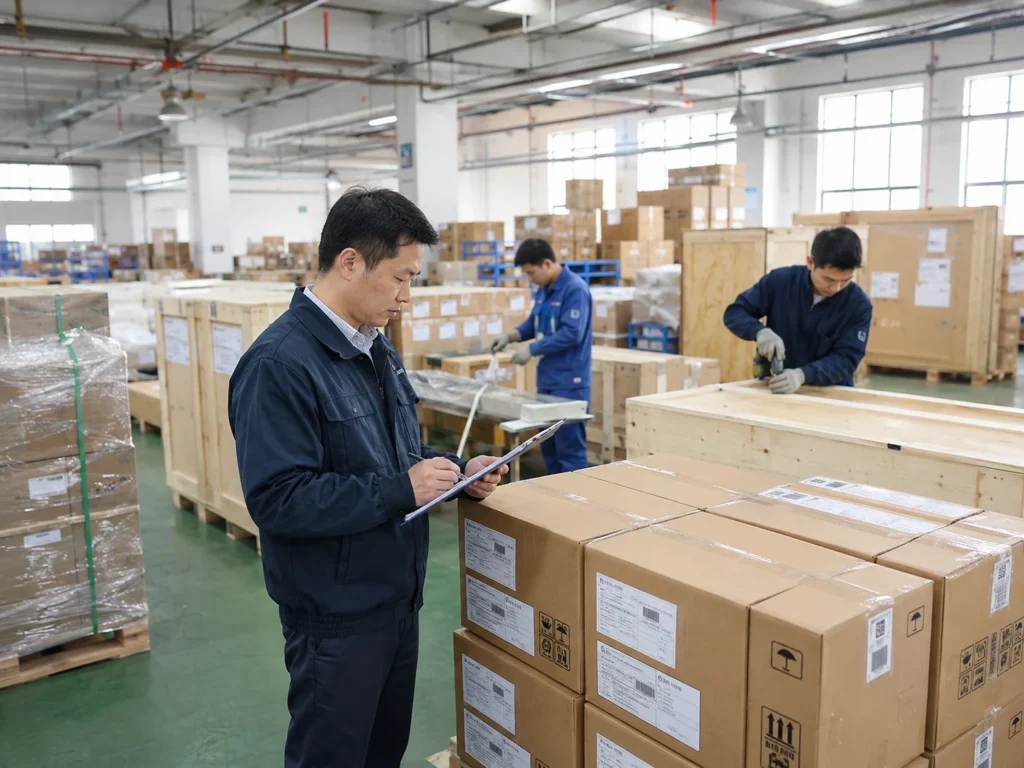
A useful update is not just “in production.” It should show date, milestone, photo or video, supplier answer, issue found and next action. The format can be simple, but the record should be clear enough for the buyer to review when inspection, shipment or reorder questions come up.
Milestone notes
Order confirmed, material ready, production started, mid-production update, packing confirmed, inspection booked or shipment ready.
Photo or video references
Images tied to the buyer’s order, such as component shelves, production line, packing, labels, cartons, finished goods or test run.
Issue list
Delay, missing label, changed component, weak carton, wrong spare parts, unclear quantity, revised delivery date or open supplier answer.
Buyer decision list
Approve revised packing, wait for correction, book inspection, accept a minor issue, request rework or hold shipment release.
Follow-up Boundaries
Production follow-up is not the same as factory management
We can ask for updates, organize records, press for missing answers and point out visible gaps. We are not the factory’s production manager. The supplier still controls workers, materials, machines and daily scheduling. The buyer still approves payment terms, product changes, inspection scope and shipment release.
We follow agreed milestones and issue points. Staying inside the factory every day is a different arrangement.
Progress photos do not replace an inspection of finished goods, quantity, packing, labels and visible defects.
Photos and supplier videos cannot prove hidden material, electrical safety, chemical composition or long-term performance.
We can coordinate release notes and packing list questions, but the buyer’s freight forwarder handles transport responsibility.
FAQ
Questions buyers ask about production follow-up in China
When should production follow-up start?
It should start after the order, accepted sample, packing details and delivery target are clear. Starting before those points are fixed usually creates noisy updates.
Can production follow-up prevent every delay?
No. It can reveal delay signals earlier and help push for answers, but material shortages, tooling problems, buyer changes, rework and factory scheduling can still affect timing.
What photos should suppliers send during production?
That depends on the product. Common photos include material or component arrival, first production pieces, line progress, mid-production quantity, packing samples, carton marks and finished goods before inspection.
Does production follow-up replace inspection?
No. Follow-up tracks progress and catches missing details before goods are finished. Inspection checks finished goods according to the agreed scope.
What happens if the supplier reports a delay?
We ask what caused it, which milestone moved, what correction is possible, whether inspection or loading must be rescheduled and which decision the buyer needs to make.
Can you follow production with suppliers I already chose?
Yes, if the order file is clear enough. We need the supplier contact, quotation or proforma invoice, accepted sample notes, quantity, packing details, delivery target and open concerns.
Send the order stage you need followed